
















|

Decoding American History's Lost & Hidden Treasure: Author C.V. Pratt Explores How to Apply 90 Percent Rule to Treasure Hunting
By Andrea Marvin
With over 35 years of military service, author Dr. C.V. Pratt has extensive experience in joint wartime planning, where he has applied the 90 percent rule to solve problems.
The 90 percent rule is about planning, preparation, and execution, so that the action, the remaining 10 percent, is much easier to achieve.
The methodology is the impetus for Decoding American History's Lost & Hidden Treasure: The 90 percent Rule: A Methodology for Planning, Preparation & Recovery, the latest book in his series that uncovers lost treasures.
After realizing he could not analyze the possible locations of all of them, Pratt decided to teach his readers how to apply the 90 percent rule. Pratt covers how to conduct research with old and new maps and how to uncover facts from fiction with technologies.
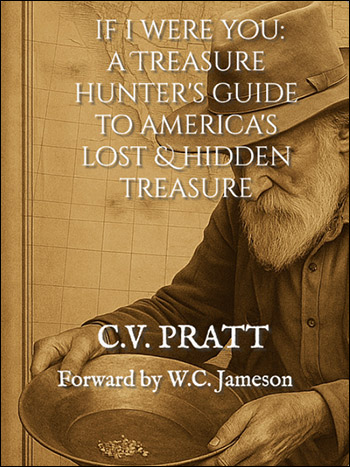
Decoding American History's Lost & Hidden Treasure is divided into 12 chapters that help readers develop a workable theory and create a plan for their own treasure hunt.
Author C.V. Pratt is a dedicated treasure hunter who combines deep research with engaging storytelling. His series is inspired by a book his daughter gifted him, Lost Treasure of American History, which intrigued him to explore whether the treasures mentioned in the book still exist.
Pratt shares how this launched his storytelling process, which involves pulling apart a published treasure hunt, and determining whether the treasure still exists and its likely location.
During an interview, Pratt shares how his background influences his research process, based on testimony, geography, topography, and the reenactment of events.
Pratt is a retired Air Force Colonel and an Assistant Professor at the National Defense University and Air University, where he teaches joint military strategy and warfare planning.
He has a deep appreciation for American history and hopes his book offers insights into the past through the lens of exploration.
How did you come up with the idea for your series on treasure hunting?
I'm a retired Air Force Colonel who served for 35 years and was involved in joint wartime planning. I have this whole process for planning, preparing, and researching, and I teach on this subject too.
Treasure hunting captured me. I had been dabbling in treasure hunting for years, never super serious, but more on the research side of it.
The idea for my series came from a book I always travel with from my daughter, Lost Treasures of American History by W.C. Jameson.
In the first chapter, there’s this Spanish galleon supposedly in the California desert. I started researching whether the treasure exists, going through periodicals, reading old newspapers, and talking to people. By the time I was done, I had a thick notebook of notes.
I realized it would be hard to reiterate, so I put it together to read like a chapter book. Then another treasure hunt came up with Justin Posey. He bought and rehid part of Forrest Finn’s treasure and created his own treasure hunt.
Again, I compiled a notebook of notes and wrote a chapter. Once I had two chapters, I contacted W.C. Jameson, the author of the book that I studied, and showed him my manuscript.
He thought I had something that went deep into researching, planning, and coordinating treasure hunts that no one else provided, because treasures are secrets that you don't want to give away.
I realized I wouldn’t be able to find all these treasures, so I decided to apply my 90 percent rule. Different writers have provided concise background information on the tales. Still, I decided to go full-blown with it by conducting an analysis, retelling the story from multiple perspectives, and identifying a target location.
Basically, if I were you, here's the guide and solution sets to these treasures. That’s how my writing journey began, and I couldn't stop. I started doing this story-by-story for a long time, until I could parse it into three volumes.

Explain the methodology behind the 90 percent rule and how it’s applicable to treasure hunting.
My fourth book, Decoding American Histories’ Lost and Hidden Treasure, is coming out at the end of December.
The book is 200 pages long and divided into 12 chapters that cover the 90 percent rule. It breaks down how you take a myth or a story, pull it apart, identify what is fact from fiction, and come up with a workable theory.
You must start with a framework by digging into the characters, asking who, what, when, where, why, and how.
You want to answer all those questions about each of the characters in the story so that you can find out their motivations. Why did they hide this treasure? Were they on the run? Were they storing it outside their house because there were no banks at the time? What was the impetus of the story?
The 90 percent rule is to do as much fundamental research as possible with old and new maps and different technologies to uncover the facts of these stories and get closer to these hidden treasures.
It’s about planning, preparation, and how you execute your search to recover it legally.
I used the 90 percent rule as a senior officer in the military. We have to solve problems all the time. I have found that before you take action, you need to do the 90 percent. Get that done, and the remaining 10 percent will be much easier.
Wars are fought that way. There’s extensive planning for managing conflict. It has really helped me in life, and I applied it to treasure hunting while deciphering and decoding situations.
If you were to go on a treasure hunt in one of my volumes or want to find a treasure not mentioned, take my decoding book and go through my 90 percent rule methodology.
This will give you a much higher success rate than bringing out the metal detectors. You’ll never find it that way; it’s just near impossible.
How does volume III move your series on treasure hunting forward?
I divided these volumes into sections that go together. Volume III focuses on lost mines and hoards. There are a ton of ways to lose a mine, and there are stories about this. The person can be killed, so the mine is lost because no one else knows about it. It may have been talked about, but no one knows where it is.
For example, when Native Americans were displaced on the Trail of Tears to reservations, the tribes were forced to abandon many mines where gold was kept secret, blending into the surroundings of their homeland.
Those mines were never disclosed, which you’ll read about in a couple of chapters.
Then I get into hoards, a situation where someone quickly buries stolen property while on the run. An example is a stagecoach being robbed, with the perpetrator running off with the treasure and hiding it.
Perhaps they get killed or go to prison and never get back to it. Maybe they tell a prison guard or a warden, but the treasure is never found. These treasures are usually hidden in haste while on the run.
During deep research on this, based on testimony, geography, topography, and reenactments of what happened, it’s like finding a needle in a haystack. How far could they have gotten before burying it, and what was the landscape like?
Other examples are people who would hide treasures for location reasons, such as someone living on a farm without a banking system. If you dealt in gold and silver with merchants, you would have to bury it; that was your bank. There are many stories on that in volume three.
Volume III is the best book in the series so far. When you write more, you develop your writing voice and find a deeper methodology to present it in print. My editor says it's the best one yet.
How would you describe the overall layout?
I take the treasure's initial story from a book and compare it to narratives from newspaper clips, journals, testimonials, and other authors. I put all this together to see if it rhymes and how the story could differ from the telling.
Then I put the information into my own narrative and retell the story. I tell it with more depth about the characters, which I find essential for deciphering any myth or legend.
The information is divided into sections on topics such as time analysis. What was the environment at the time like? Was it a Civil War environment? Did a robbery occur? Did it happen in a desert, forest, or the mountains?
Many of these stories feature geography integral to the story, so I conduct geographical and environmental analyses to assess the plausibility of the treasure's existence.
Another section touches on analysis, coordinates, and looking at topography. This includes looking at old USGS maps dating back to the 1820s and comparing them with modern Google satellite imagery and local maps from state and regional archives.
There are some of these old maps with roads that have long disappeared and are no longer on modern maps. I'll start putting in coordinates, which I call search zones.
If you do all that and apply the 90 percent rule, the 10 percent should fall within these zones. After that, I outline how to recover the treasure in six or seven steps.
In another section, I discuss legal considerations, given that each state has different laws. I also provide an annotated bibliography listing all the sources I've used for each chapter.
The book is very research-oriented yet entertaining and not dry. The retelling of the stories is engaging, and each chapter is processed and summarized effectively.
Who would enjoy reading this book? People interested in history, those who like to solve problems?
The audience is broad. I earned one of my Master’s in U.S. military history. I love the subject and have been published on it.
There are some history people out there who would really like to know these stories, small pieces of history not typically published about.
American history tends to focus on significant events but not on individual stagecoach robberies or lost mines. This digs pretty deep into American history, which is not tame. People have died trying to hide and find treasure.
Some of the stories I researched are gut-wrenching. My audience would be anyone interested in American history, especially the Wild West.
Also, conspiracy theorists would enjoy the book. I'm trying to solve a mystery, a complex puzzle with a variety of variables. And of course, treasure hunters.
There are many venues for people and groups who would love to read it. I made it entertaining but also informative, analytical, scientific, and realistic.
Tell me about your path to becoming an author. Did you always want to write a series?
To be a professor at the National Defense University and at the Joint Forces Staff College, I had to publish. I earned a PhD in business administration and wrote an article on the Revolutionary War for a joint military magazine. That was my first publication.
I've always wanted to write a book, and this series fell into my lap. I had no idea I was going to write it.
Once I collected notes on treasure hunts and got my system down for how I wanted to present this 90 percent rule, I couldn't stop. I was writing for days and weeks on end, sometimes 12 hours a day, because it takes a lot of research.
The discoveries you make are just surreal as you see how it all comes together. Once I got enough stories to create the first volume, I was really excited.
After finishing volume one, I realized there were so many stories out there that could use this type of research, analysis, investigation, and interpretation, so I just kept going.
When I reiterate and explain the 90 percent rule, I get some closure on this process so that it would benefit people, my real impetus.
What are you working on next?
Having a few books coming out a few months apart from each other, my focus right now is getting the word out about them. I really don't want to write again until I've spent significant time in the field.
We're going to go on treasure hunts next year, so I'll be focusing on that. I have four hunts out of my three books I’m going to go on immediately because I have a good feeling about those. I'm going to go out on the hunts as if I were you.
Author C.V. Pratt is also creating a social media series called The Treasure Files, in which he covers each of the chapters from his book series. The series gives a glimpse into the history, research, and mystery behind each story.
He is also planning next year’s fieldwork, which includes four sites from chapters in his books. Pratt explains if there's a demand for a fourth volume, it would be about discovering new tales that have not been told.
Pratt encourages people to connect with him through his website and submit ideas about legends they’ve heard of.
For more information on purchasing Pratt’s series, and latest book, Decoding American History's Lost & Hidden Treasure: The 90 percent Rule: A Methodology for Planning, Preparation & Recovery, visit https://cvpratt.com.
Home |
Actors/Models |
Art |
Books |
Dining
Film & Video |
Food & Wine |
Health & Fitness
MediaWatch |
Money and Business |
Music |
Profiles
Professional Services |
Sports |
Style & Fashion
Technology |
Theatre |
Travel & Leisure
Copyright 1995 - 2026 inmag.com
inmag.com (on line) and in Magazine (in print)
are published by in! communications, Inc.
www.inmag.com
|


Advertiser Info
Subscription Form
Contact Us
|

