
















|

The Ultimate Student Advocate:
Interview with Betty Blackmon
By Carin Chea
A passionate educator and life-long mentor, Betty Blackmon discovered during the pandemic that she was a virtuoso when it came to advocating for students.
Specifically, Blackmon (a seasoned social worker and tenured professor) recognized the silent cries of students struggling to navigate the new and unfamiliar world of online learning that emerged as a result of our global health crisis.
While institutions were focused on adapting to this new normal, their students were drowning in uncertainty and confusion.
Unable to ignore this growing need, Blackmon has drawn from her abundant well-spring of knowledge and expertise as an educator to give those struggling students a much-needed life raft. The course of education has inevitably changed and will never be the same.
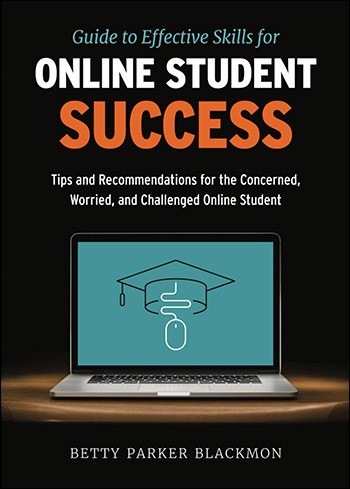
Blackmon’s book, Guide to Effective Skills for Online Student Success, is not only an indispensable tool for right here and now, but indefinitely.
Have you always been a writer? Or, did academia precede your career as an author?
Academia forces you into writing because part of what you have to do is publish your work in order to get your tenure and promotions. That started me on my road to writing because you have to do it.
They let you know that teaching is not your primary purpose. Your purpose is getting out articles and things like that, doing research.
After I received tenure, I concentrated on writing things that focused on the “gap”. And one of those gaps was the use of technology in social work.
What inspired you to write your book?
This book came from seeing and reading articles about the number of students who were dropping out during the pandemic. Most of these students were black and brown students. Partially, they were having to work now, then go into a medium [online learning] they were unfamiliar with.
Institutions were unfamiliar with how to really get online courses accredited and so many instructors have not studied how to effectively conduct online courses. This resulted in “emergency crisis training.”
What got my attention was I saw that 25% and up of African American and Hispanic students were dropping out in college. It’s really about the design of the courses and there are standards that exist.
I just recently heard from a colleague that they’re now trying to set up an accreditation model where anyone teaching online courses has to be certified, and all courses have to be certified.
The big question is: who are they going to get to do that, because it’s not consistent. It’s happening in undergrad.
Imagine what’s happening to children in elementary and secondary schools. Many of their teachers and instructors were not trained to do online. They go online, spend 15 minutes on a worksheet, and then sign off. That leaves the parents to do the rest of the teaching.
With appropriate resources and training, you could really replicate a lot of the activities that go on in a classroom. I always try to put virtual rooms out there where students can talk to each other.
Peer interaction helps learning because leaning just doesn’t have to come from the front of the room. It doesn’t just come from me.
I dedicate an entire chapter where I encourage people to start their own peer groups and structure it so it is meaningful.
I also felt social work was far behind in using that technology, and we can develop it. I see it as a social justice issue. There are so many people who have to work. That’s why so many Hispanic kids dropped out.
Nobody tells you there are videos and tutorials on how to work online on the learning platform.
What inspires you as an educator?
I know that you have to have the skill set to become an effective a social worker. Theoretical approaches work. I taught theory; theory doesn’t have to be boring and it helps you explain things, what you’re seeing.
You want to have multiple ways of viewing the people you’re seeing. You have to select theories that pick on the social contexts of different populations.
Students need to know what lens to see different people. That’s why I like teaching. We have to learn to see people as different, and then not see different as negative. You have to be open to understanding different people and giving people choices.
When I was a practicing social worker, I remember once having some clients who were older white men who were homeless. They came in with the attitude: “I’m not going to participate with this kid.” I didn’t know them.
I said, “I don’t know who you are. Help me understand how you got here.” That was helpful because I acknowledged I was different than people they were used to seeing.
I recognized that I didn’t grow up in the foothills of Missouri; I had to learn their culture and the significance of that culture. That was so different from where I was from. I wanted to have enough tools to see them. If I only know one theory and one lens, I wouldn’t have been able to see them.
Also, I love it when I get phone calls from former students and they repeat to me what I’ve taught them earlier. I try to do mentoring because a lot of students are faced with taking licensure exams. I help them navigate that.
Was there an “a-ha” moment when you realized you needed to write this book?
There was a call for papers for a monograph. They told me they’d publish my work if I re-framed it so it’d be geared towards teachers.
I said, “What about the young people in our courses? Who’s writing for them?” I did a book and prints search, and I couldn’t find a thing. That was my a-ha moment. Who’s telling these students how to navigate online courses when they would rather be sitting in a classroom?
Tell us about Guide to Effective Skills for Online Student Success. Is this your first book?
Yes, this is my first book. I’ve had book chapters but not a book.
Now, it used to be where a university would make the learning virtual for a snow day. But, they’re only making the lectures virtual; it’s not truly an online course.
We need to create environments where students can talk to each other, see tutorials, documentaries, and see their course goals and objectives. There are videos now telling students how to navigate the platform.
You need to tell them that. So many people assume students already know it all. I tell my readers there are maps and guides available to them. Get to know your IT department. A lot of students don’t talk to their professor, even when it is an in-person class. I recognize that.
You put up virtual office hours and you use things to get them to come to you. I want students to talk about the barriers they may be experiencing. Communication with your professor is key; you need to seek them out. Talk to them throughout the course. Do those kinds of things. That makes a big difference. It makes a big difference for grades too.
I implement tools like discussion boards. I also included writing guides. You’d be surprised how many students don’t know how to outline their paper. The majority of students don’t do an outline.
Online, it’s even harder when you do your paper and approach discussion boards. It’s not just talking the way you would in an in-person class.
I also talk about the syllabus. Students see the syllabus one time and they’re done. But, you can use it as a tool or guide. It gives the subtle expectation of the professor. You need a plan for how you’re going to learn. This book is geared to the self-motivated and self-directed.
Do you have any upcoming works in the pipeline?
I’m focusing on books I had laying in a box. Take a look at what's going on in the world today.
How do young people manage to stay whole and healthy? One of the lenses I see education through is: How do you help? Everybody’s got the ability to help in their own way.
Home |
Actors/Models |
Art |
Books |
Dining
Film & Video |
Food & Wine |
Health & Fitness
MediaWatch |
Money and Business |
Music |
Profiles
Professional Services |
Sports |
Style & Fashion
Technology |
Theatre |
Travel & Leisure
Copyright 1995 - 2026 inmag.com
inmag.com (on line) and in Magazine (in print)
are published by in! communications, Inc.
www.inmag.com
|


Advertiser Info
Subscription Form
Contact Us
|

