
















|

The Art of Talking Normally:
Interview with Dr. Whitney Hegseth
By Carin Chea
Back-to-school season elicits a complex and wide array of mixed emotions. One sentiment frequently joked about on mainstream media is the anxiety and fear that educators have towards their students.
Conversely, the yin to this yang is the all-too-familiar child who doesn’t feel understood. We’ve seen this endlessly in film and television, but its roots are anchored in reality.
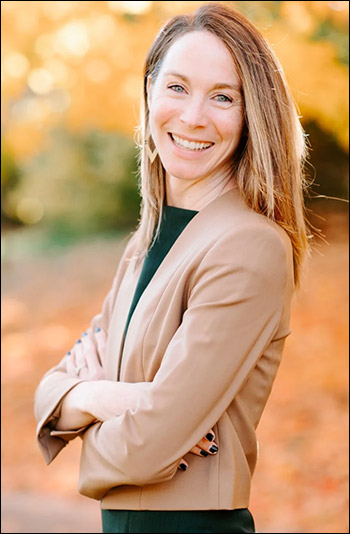
Dr. Whitney Hegseth, a pre-eminent voice in educational leadership, is an expert on effective student-teacher communication. Dr. Hegseth, who is an assistant professor at the University of La Verne, is a much-needed voice for educators struggling to connect with their students.
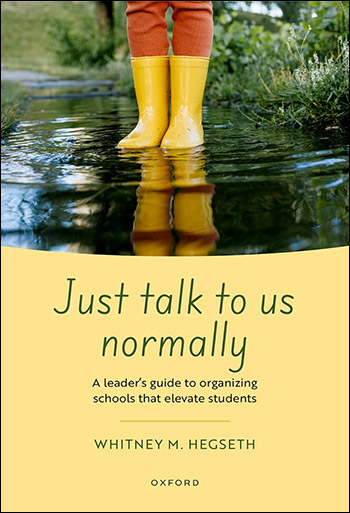
Her recent book, Just Talk to Us Normally: A Leader’s Guide to Organizing Schools that Elevate Students, is a tool every teacher, principal, or superintendent should have if they want to break barriers and form authentic relationships with their students.
The very core of Dr. Hegseth’s work is dedicated to the universal principle that all people want to feel truly seen and heard.
Just Talk to Us Normally is an invaluable guide for educators who want to initiate cultural change, one student, one classroom at a time.
You have such an illustrious career. How did you get started in the field of education?
I always had several jobs growing up. They often were centered around children, whether it was babysitting or tutoring. I’ve always really enjoyed it. I preferred children to any type of humans on this planet.
I studied anthropology as an undergraduate, and loved that major. I became interested in the different ways we teach and treat children around the world, so I studied the anthropology of education.
In undergrad, my thesis adviser was Laura Nader (who is Ralph Nader’s sister) and she taught a course called Controlling Processes, which focused on how different things in our society can control us without us even realizing. I applied that to education.
After my undergrad, I knew I wanted to be a professor and that I wanted to keep studying education. I needed to have many types of educational experiences in order to do so.
Professionally, I was a teacher and a professional researcher in the US and a few other countries as well. I was constantly in different states and countries to challenge my own understanding of things.
What was the impetus to write your book Just Talk to Us Normally?
Technically, this book was based on my dissertation research. I think it was a lifetime of experiences that led me to tell this story.
As a child, then a teacher and parent, I’ve observed that we as a society tend to chronically underestimate our young people, particularly when they’re young and Black, or young and female, or young and a recent migrant.
This book is a culmination of my efforts to challenge all that.
I totally agree. I remember feeling that way as a child, and I still believe we underestimate children today.
What’s disappearing from childhood right now are opportunities for practicing independence, resilience, and social skills. We don’t have as many opportunities for those things right now.
Previous research has examined the surface area that children roam across time. As time has gone on, that surface area has dwindled even though crime rates have stayed the same or diminished.
If you think about it, our childhood was more free-range than what it is today. How uncomfortable are you if you see children using a knife to cut a vegetable? Or, how uncomfortable are you to see children arguing in the playground?
Though our intentions are often good, we frequently intervene, and this communicates to young people that we do not think them capable.
This is true! I remember kids used to be so much more free-range back then. More responsibilities too.
When I studied education in different countries, I saw the different moves that various educators were using.
One of the cases I highlight in my book stems from the Montessori education system. (This is also the case in the Japanese educational system.) Those class sizes are a lot larger than the ones we push for in the US. That’s intentional.
If the teacher is in charge of a large class, they are necessarily restrained and cannot intervene as much. As time progresses, students learn to help themselves and their peers.
Teachers witness this and see how capable their students really are. In doing so, this beautiful cycle is perpetuated. The goal in these classroom settings is social harmony and community building.
I’m not here to tell any educator or parent what they should be working toward. I’m trying to help folks see their own instructional supports more clearly and how to manage them in order to work toward what they desire for their students.
Your book is a leadership guide. What made you go into this specialized field?
My favorite people are children, but a close second are all those folks who educate them – the whole ecosystem around a child’s day.
The work they do is so hard, and it seems it is getting harder. I use this comparative lens to support teachers, principals, and superintendents in the work they’re already doing.
I am also a professor at the University of LaVerne, so I very much had my own students in mind as I wrote this.
What would you say the central message of your book is?
Before folks start reading, something I ask them to assume is that children are far more capable and good than we often realize.
If we can hold that in our minds, a key lesson is that educators can change culture. They can use their instructional support to systemically improve how we see and treat young people.
There are many ways to do this work, and in my book I show some of those options. The decisions you make have implications for your work, for the practice of the teachers, and for the experiences children have throughout their school day.
The decisions you make have implications for the fundamental beliefs young people have about themselves.
The message I want to convey is that, as an educator (regardless of what level or school you’re at) you have the power to transform beliefs and actions towards children. And, depending on how you go about that, the choices you make have implications for educators and young people alike.
It’s really hard to be a parent or educator. We often lean on the way we were treated when we were young. When in doubt, just ask the kids.
The title is actually a direct quote from a 9-year-old I was doing research with. In a focus group I facilitated, children were watching a video of a classroom in a different educational system.
This child remarked that the teacher in the video was talking to her students like babies, and the girl said, “Just talk to us normally. We’re not babies anymore.”
What age groups do you primarily focus on in your book?
Most of the research I talk about is based in elementary school, but a concept I talk about is infrastructure, which sounds like a big term.
But infrastructure is simply all the things that support teaching or learning, whether it’s a curriculum or professional development.
How can we use all of those supports to work towards the change we want? Those lessons around infrastructure can really apply to folks in leadership positions from pre-k and up to higher education.
What advice would you give to educators who are just starting out on their careers?
I tried to write this book so that it’s truly a support, and not an add-on to all that educators are already doing.
Just Talk to Us Normally is a tool to see the work you’re doing more clearly. This is a book about how to change culture. How do we systemically improve our beliefs and actions towards children? That’s very hard.
It’s hard to change culture and deeply-held assumptions and habits, and the broader society isn’t helping things.
This is the story of culture change, but also a detailed guide on how to do the work you’re already doing so that you can feel supported in being transformed.
Also, make sure you keep resting. This work is brutal. So much is placed on our teachers that is so far outside their control.
But one bit of advice is just to remember the lesson we all learned in kindergarten and apply it to children: Treat others the way you want to be treated.
For example, if I had a colleague who seemed really busy with something across the room, I wouldn’t shout at them and talk to them right away. I’d walk across the room and approach them when they were less busy. And yet, we interrupt kids all the time, even when they’re immersed in something.
That’s a really insightful perspective. We are quick to intervene with kids, and in a really abrupt way too.
Right? If a co-worker of mine is struggling with something on his computer, I’m not going to march over to his desk and start typing on his keyboard for him. I’m not going to do his job for him.
In the same way, imagine a student tying her shoelaces. Why not allow them time to figure it out, and maybe go over after some time and check in? If we wouldn’t do a colleague’s work for them, why not treat a student the same way?
This work is hard, and it requires a cultural shift, and it’s that cultural shift I’m trying to foster in my book.
Are there any upcoming works you’d like us to know about?
At the University of La Verne, we are teaching our doctoral students action research, which is going in and seeing a need within your school or district, designing a change initiative, trying it out, and then systematically reflecting on it.
I’m interested in the action research done by educational leaders all across the country, especially those doing youth participatory action research, where the youth have a say in how to improve their classroom or school.
Another thing I’m trying to emphasize: the power of comparison.
I compare across various educational systems (for example, public, Catholic, or charter), but also education in the US versus other countries.
I’m not here to say which approach is better, but I do think that the more we look around and see how others are teaching and treating children, the more we clearly understand how we’re doing it, and how we might want to do it differently.
For more information, please visit www.whegseth.com
Home |
Actors/Models |
Art |
Books |
Dining
Film & Video |
Food & Wine |
Health & Fitness
MediaWatch |
Money and Business |
Music |
Profiles
Professional Services |
Sports |
Style & Fashion
Technology |
Theatre |
Travel & Leisure
Copyright 1995 - 2026 inmag.com
inmag.com (on line) and in Magazine (in print)
are published by in! communications, Inc.
www.inmag.com
|


Advertiser Info
Subscription Form
Contact Us
|

