
















|

Medical Mythbuster:
Interview with Dr. J. David Prologo
By Adeline J. Wells
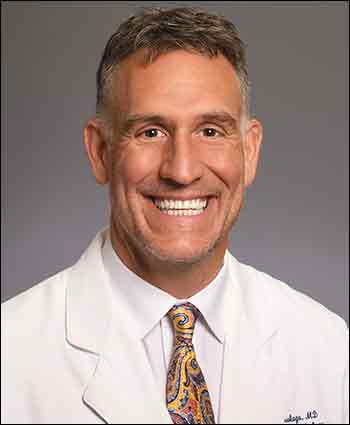
In a society where everyone seems to have a different idea as to the best way to get fit, Dr. J. David Prologo is here to set the record straight.
An interventional radiologist with training in obesity medicine, he has spent his career fascinated by people trying to lose weight, but who consistently run into obstacles within their own bodies that seem to stop them.
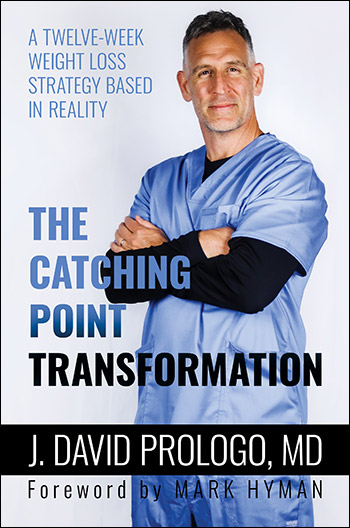
Dr. Prologo addresses this phenomenon in his new book, The Catching Point Transformation, as well as why other weight-loss techniques are not successful in helping patients achieve their goals.
Referring to a mathematically defined point of the weight-loss journey, The Catching Point Transformation details how people can reach and enjoy a healthy lifestyle with ease.
Could you speak a little bit about your background, as well as what drew you to the world of obesity medicine and weight loss?
My interest in weight-loss medicine was actually sparked before I went to medical school. I was a typical athlete in my early 20s; a lean person who enjoyed working out. I lived with my mom and some other relatives who were not like that; they would try to lose weight over and over again.
Watching this, I became fascinated with this idea that people just couldn't lose weight. I went to medical school and received my formal training in interventional radiology, followed by obesity medicine.
I spent the academic portion of my career researching exactly that phenomenon, which was, why is it that everyone is failing these mathematically-correct diets and negative calorie balance programs?
As I was working on that, the CDC published statistics saying that 50% or more of people were failing two diets a year. I thought that there had to be more to this than simply that people were mentally weak, don't really want it, or any of those explanations that we hear.
Over the years, it became clear through others' research and my own that there are biological survival signals that stop people.
What prompted you to write your book, The Catching Point Transformation?
The entire purpose of the book was that I wanted people like my mom to realize that what they felt was true and founded in science. So many people find other medical issues that they believe contribute to these programs’ failure, such as thyroid issues or bad genetics.
What they're trying to say is that when they try to follow a program, something stops them. They are absolutely correct about that; there are about five or six things that are stopping them.
Unfortunately there's no real motivation for the broader fitness industry to solve this problem and get this information out there to people.
The Catching Point Transformation is a resource for people to overcome this themselves, ending this cyclic billion-dollar industry. Here's all the evidence and all the proof for what they’ve been saying all along, and how to overcome it.
Where does the title of the book come from?
I titled the book The Catching Point Transformation because part of it is a reflection on what people already know, which is that there are two camps of people.
There are people like myself, who have always been lean and enjoy working out. Then there's another camp of people who are trying to use those tools, such as working out and eating clean, to make a change.
The great mistake that everyone makes is they try to go directly from one camp to the other; it won't work because there's an expanse in between that can be divided by this “catching point.”
Once we get people to the catching point, then what changes is they change from someone who has a terrible experience with exercise and dieting to somebody who enjoys it.
When you watch somebody get through that point and switch camps, then you realize that their entire life has changed; what was so difficult before is now enjoyable, and that's kind of a magical transition.
The catching point itself is not some cloud idea, but rather a quantitative spot defined by a certain amount of exercise capacity.
The Catching Point Transformation not only looks at why diets fail, but also why we as society tend to blame patients for that failure. Why do you think that tends to be true?
People have called it the “last accepted prejudice.” Prejudice occurs because the people who perpetuate such ideas have never been in the other person's shoes.
It's because people have grown up lean their entire lives, enjoying working out, and they don't know what it's like to try to make a change. It is a different experience than exercising and eating clean just to maintain your lean.
They don't understand the details of what it's like to be in the other’s situations; they don't feel the forces that they feel. Due to that disconnect, they turn it back on the patient.
What sets your book apart from other techniques and references on the market?
The Catching Point Transformation is not at all like other weight loss programs; rather, it is an explanation for why those diets fail and provides a scientific solution to them.
I had a very difficult time getting this published because people don't want different. Publishers would ask me to just make it a simple fix, such as “90 Pounds in 90 Days.”
The Catching Point is the opposite of that; I'm providing CDC statistics that prove those programs don't work. The primary thing that makes it different is that it’s an explanation founded on science.
Secondly, it's about getting people to that catching point, so that their lifestyle change is not a miserable thing. It's not a gimmick and it is meant to validate what people are already feeling.
What do you consider to be some of the biggest issues with the way our society views dieting and weight loss today?
The biggest issue is that we sell people an undoable program. This would never fly in any other sort of business, yet in the weight loss industry we're selling these products that don't work, and we've convinced the buyer that it's their fault. It’s an ethical nightmare, and I think that is the worst thing that we do.
They don't work because we put people on a negative calorie balance, often increasing their exercise at the same time. The body receives these signals as if it is experiencing a famine, and immediately goes into survival mode.
It slows down its own metabolism and stores everything that you eat, because you've sent a message that you're starving, and it will send you on a food-seeking mission.
You won't be able to overcome those survival-based signals as long as we set them off the way we do.
What is the impact that you would like for your book to have, both for your readers as well as for society at large?
Most importantly, I would like to get the message out there to those who have struggled with weight loss in the past that you’re correct about this resistance that they feel inside their body. We understand that you're telling the truth, and that you're right; your body is fighting you.
The second thing is that there is a different way to lose weight. People are happy to know that I've validated the way they feel, but they don't want to leave it there; they want to achieve their fitness goals, and The Catching Point can help them do so.
You advocate for people by “driving an agenda of acceptance, inclusion, and love.” With that said, how can people best support others on their journeys of weight loss?
Immediately admit it if you haven't been through this experience of being overweight and trying to change.
If you haven't gone through that transition, then recognize that you don't know what it feels like, and you are certainly not sure that you yourself would be able to succeed if places were switched.
That is the fundamental misunderstanding that human beings have, that you're a “better” person than the other. There's nothing to support that; it's a nonsensical thing to think, and it just leads to further perpetuating this problem.
Do you have any other future books or projects on the horizon?
I'm working on a docuseries that follows this theme of misunderstood medical issues, not only for weight loss but also for mental illness, as well as for patients who experience pain.
If you've not experienced these issues, it's easy to judge these folks and make false assumptions. I have one docuseries that focuses on that, and then a second one that focuses specifically on the difficulty of weight loss from the patient's point of view.
Is there anything else that you would like to touch on or expand on?
I talk in the book about a lot about things that people can do themselves differently, but there are also things that we can do as obesity medicine physicians and doctors to help ease that transition.
I know people are interested in that, and we pursued that for all the same reasons. Any procedure that I do for you is not a willpower implantation procedure, but rather something to help the body’s response to calorie restriction to make things easier.
For more information on Dr. Prologo’s work and The Catching Point Transformation, please visit www.CatchingPoint.com.
Home |
Actors/Models |
Art |
Books |
Dining
Film & Video |
Food & Wine |
Health & Fitness
MediaWatch |
Money and Business |
Music |
Profiles
Professional Services |
Sports |
Style & Fashion
Technology |
Theatre |
Travel & Leisure
Copyright 1995 - 2026 inmag.com
inmag.com (on line) and in Magazine (in print)
are published by in! communications, Inc.
www.inmag.com
|


Advertiser Info
Subscription Form
Contact Us
|

