
















|

How the Creative Projects You're
Meant to Work on Will Find You
By Samantha Skelton
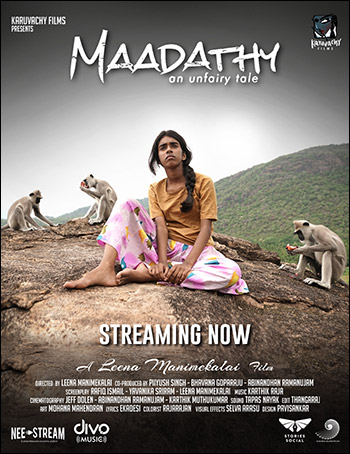
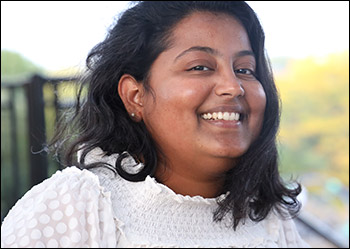
Bhavana Goparaju wasn't exactly looking to be a producer on an award-winning film like Maadathy: An Unfairy Tale, but this impactful feature film that deals with social issues the world needs to hear more about, found her at a time in her life when she needed it most.
Tell me about your background and how you got interested in film?
I wrote my first poem in sixth grade. When Facebook started, I used to put my short stories and poems on there. A friend encouraged me to look at films after reading my poems.
My mom was part of a film club that would screen international movies too and I would go. I vividly remember watching Charlie Chaplin, one of my favorites.
After that, I started with writing lyrics for a Telugu movie. Then I started taking jobs in writing here and there, but it's a male dominated industry.
I was faced with interactions where people were looking at me as a woman that was hired, not as a creative in general that was hired. That didn't sit right with my conscious, subjecting myself to the discrimination as a woman, so I took a break from writing.
What did you go to school for and what made you choose film production?
I graduated with an Engineering degree in undergrad and got my Master's in computer science. I knew I wanted to create films that tell the stories I want to hear, I have seen, and I can relate to, which is so much more than being in love or being loved by a man in adulthood, but I needed to figure out my next step.
In deciding what I wanted to do, I realized the producer has the most power to decide whether a particular story can be made into a film or not. They are the decision makers.
I worked in the tech industry to make money, to make a living for myself, but I knew I wanted to go into production. What I came to realize is that my passion is storytelling, but the platform I chose is films.
How did you work it out as a film producer from a totally different STEM background?
Not everyone has that guidance and support to figure out how to provide for yourself and follow your passion at the same time. I struggled to balance both necessity and passion but I realized that's the only way I could do what I wanted to do to secure my own space in this world.
With no film school degree, and no one in my family or relatives being in the film industry to learn from or guide me, I let life and my own experiences teach me. I built my own path - from learning through the web, to paying someone to let me work on their film so that I could learn from the insider's perspective to now, producing films through my own production house.
I should say my tech startup experience, which is so organized in nature, helped me survive in this very not so organized industry. But the hardest part is to make my parents comfortable and confident about my decisions.
My parents are both teachers. In previous generations, the working class sadly were always in survival mode and they had a fear of taking risks about what they felt was an unknown path, which I understand was justified.
Realizing the only way for me to not compromise my passion and also include them in my journey was to just show them how I do what I do, and why I do it. My paternal grandmother always said 'focus on what you do,' because that can erase people telling you the generational norms of what you can't do.
I convinced my parents to the extent that they are my first cheerleaders and the best critics I can ask for. Winning their confidence helped to win this world's heart through our stories.
The film you produced, Maadathy: An Unfairy Tale, has opened a dialogue about gender/caste violence. How did you get involved? Can you tell me about the film?
I was very active in social movements during my undergrad, and owned a digital magazine, which covered many stories including rape cases and caste violence in India. I produced one feature and one short film before this one.
I was exposed to social issues very early in my life as a child because my parents are both activists and would take me wherever they went. I got to know people from all sorts of backgrounds. I grew up with a consciousness of wanting to examine the world and examine my own privilege.
The stories that I choose and have chosen in the past are the stories of people who made me who I am right now.
Right before I chose to make Madaathy, I ran a digital magazine that focused on stories of gender violence and rape cases. I was shocked to learn the truth.
One of the incidents that made me think about caste and gender violence together was a girl who was gang raped by five upper caste (what I called Privileged Caste) men, but when she raised her voice against them, she was kicked out of their village.
When I went through other stories of rape violence in the past, I realized how much caste played a role in raping a lower caste (what I call Underprivileged/discriminated caste) women. It's all about the power dynamics that are very much patriarchal in nature, which resides in the caste system.
I quit social media for a few months after working on the magazine editing these stories for my sanity. Then I came back online and saw a post from a film festival programmer about this film that was looking for co-producers. That film was Madaathy.
I felt like it was a sign and that the film really found me. It felt like it was my duty to do this movie to make the world aware of these stories after the cases I was previously exposed to.
"Maadathy" follows a young girl born into an "unseeable" slave caste group with a folklore narrative of natural justice when any other kind of justice seems too far away from the reality.
Tell me about the caste system?
Especially in the context for the western world, casteism is similar to racism in its discriminatory nature. Though in theory, especially when you ask Google or any one in power or a privileged caste person, they say the caste system was divided according to occupation.
In reality, it is false and very different and discriminatory in nature. But, just when I take the same definition and try to explain the laborers and the type of work we do, it is dynamic and always changing in society.
Through the present generation case scenario, what do you call a physics scholar who was born to a father who is a scavenger and a mother who works as a daily laborer in the fields? I will leave it to you to think about that question.
For centuries, people have been labeled and segregated according to caste, denying them the dignity of life, deciding for others who can get an education, where they can live, sit, work, enter the temple, what they can do, and who are more or less of a human being. The definition of the caste system according to occupation sounds like bullshit and transmitting it to the next generation doesn't make any sense.
It's all about the power dynamics that the elite has defined and implemented to protect their power. There are still "unseeables" or "untouchables" in our society. People are still denied jobs because of their caste.
People still use casteist slurs. People are still looked down upon because of their caste, irrespective of the work they have done. People are still denied the ability to sit at the same table as the privileged caste (upper caste) in the households.
So, the starting line is different and is like racism in it's discriminatory nature, but is more powerful in destroying the fabric of humanity.
What's the biggest message you want the world to hear and be aware of after seeing your film?
Telling this story is so important because if we can at least make one person aware of it and initiate a conversation, we can change one person's perspective.
We wanted to tell this story so that the denial of life is recorded and to make people become aware of how the right to life is taken away from people so easily. Then maybe we can actually see if things have changed and how much, by evaluating our contribution.
We live in a society where our ancestors went through hell to help us get to where we are and what we do now is what our future is. I'm not trying to tell anyone to be a certain way, but I want people to be conscious of our contribution. The most basic way of changing anything is to be aware of it.
What's something that surprised you during the making of the film?
We have rape scenes in our film. And I realized in a lot of films, they're from the point of view of the man, not from the woman. We were so aware of how to be most empathetic. Not trigger anyone but question it. We wanted to show from the lense of the victim, not the predator.
This totally changes the narrative. It's also about the "why" behind everything. Why did a man have to rape her? Why the consciousness of the man not of the question? We had to tap so much into the why.
What was one of the biggest challenges?
Finding the finances to make the film was the biggest challenge, and then how to actually show the film. There were people who did believe in this film, even though so many people said this film wouldn't make money.
We did crowd funding and found other co-producers who put up money. We were entering the pandemic when the film had its world premiere and other premieres scheduled.
It was a struggle getting a censor certificate and to travel with the film because of the pandemic. But, people who watched our film actually helped with its distribution and gave me confidence in distributing the film independently.
Where can people see the film?
It is released on Neestream and hopefully on Amazon soon. We did a North American tour this past fall at universities including some of the Ivy Leagues like Yale and Columbia University, along with Brandeis University, the University of Minnesota, St. John Fisher College, and the University of Massachusetts.
It was shown at film festivals, including the world premiere at the Busan Film Festival, Latin American Premiere at Cartagena Film Festival (FICCI'60), Indian Premiere at IFFK, etc.
Where can everyone read more about you and Maadathy: An Unfairy Tale?
You can watch the official trailer for the film here.
Watch the movie on Neestream for now and feel free to visit my website at bhavanagoparaju.com.
Home |
Actors/Models |
Art |
Books |
Dining
Film & Video |
Food & Wine |
Health & Fitness
MediaWatch |
Money and Business |
Music |
Profiles
Professional Services |
Sports |
Style & Fashion
Technology |
Theatre |
Travel & Leisure
Copyright 1995 - 2026 inmag.com
inmag.com (on line) and in Magazine (in print)
are published by in! communications, Inc.
www.inmag.com
|


Advertiser Info
Subscription Form
Contact Us
|

